Showing posts with label asana. Show all posts

Sunday, April 24, 2011

Sasha and Sarvangasana

Yoga Sutra II.46 
strira sukam asanam.
Asana is a steady, comfortable posture.1

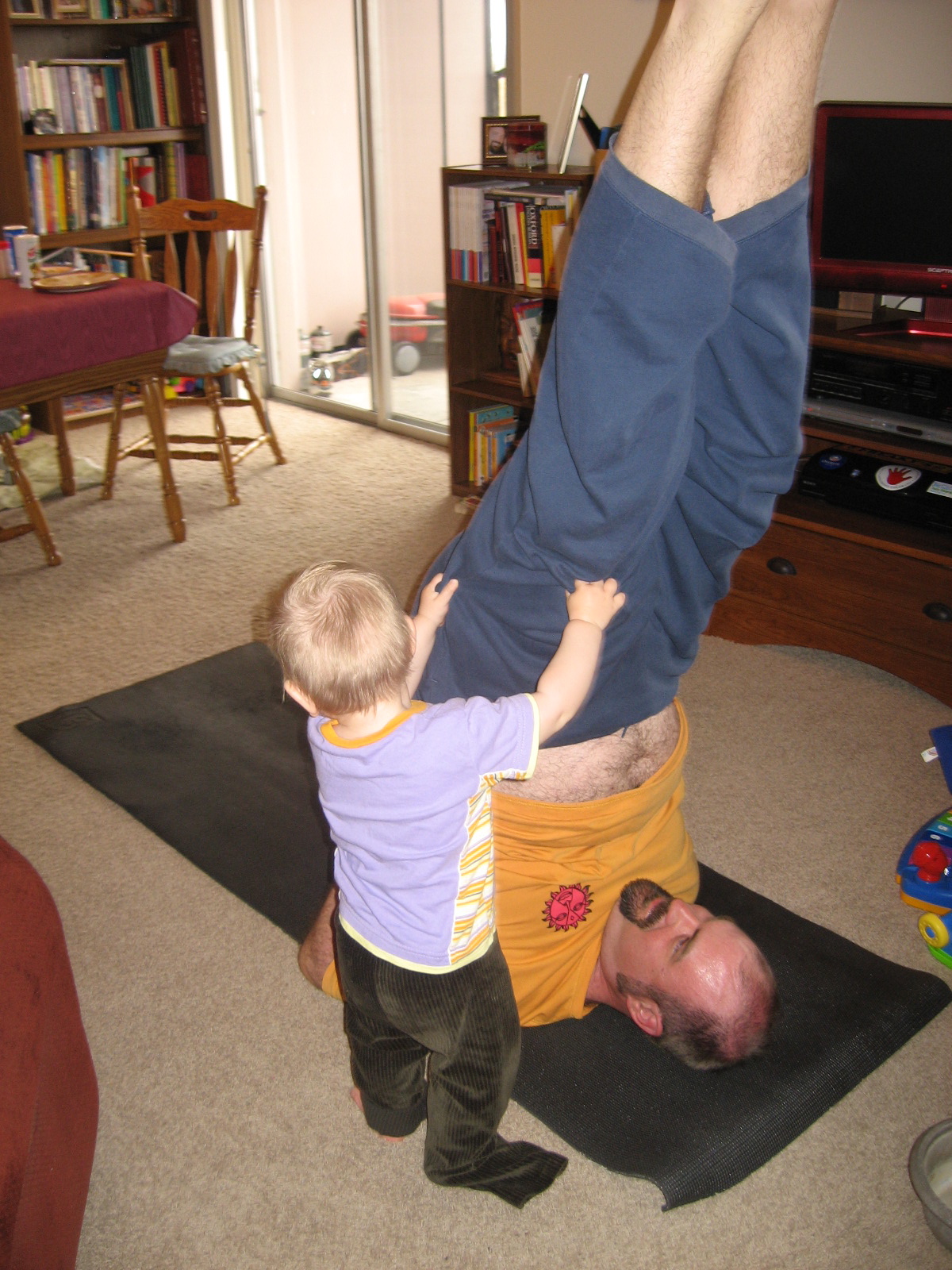
I was practicing some yoga postures on Easter morning when Sasha (short for Alexander), my 17-month-old son, crawled over and starting climbing on me.  It seems like when I want to hold him he just wants to crawl away, but when I let him be to do some yoga or something then he wants to climb all over me demanding my full attention.  He is not walking yet, so this morning he decided to use me in shoulderstand (sarvangasana) as a prop to stand up.  He finds it hilarious when I try to practice yoga postures.  Although my shoulderstand is far from perfect as you can see in the picture, with Sasha hanging on to my pants laughing at me - this was a perfect posture for a perfect moment.

A comfortable and steady posture helps prepare the mind for meditation.  The various postures help us tune into the moment, by acting like a harness to yoke the wandering mind to the body.   With each changing posture I'm reminded of how the moment passes and I can not cling to it because it will always slip through my fingers and crawl away just like Sasha when I try to cling to him.

1. translated by Sri Swami Satchidananda. Integral Yoga. (pp. 178-179).
Sunday, September 12, 2010

Are the Batteries Included?

Yoga Sutra I.12: abhyasa vairagyabhyam tan nirodhah
The mind can be stilled with practice and detachment.


Yes, a "yoga battery" is included! It can be found in sutra I.12. On the positive side we have practice (abhyasa) and on the negative, detachment (vairagya). This is the first sutra to answer the question "how do I still the mind?" And the answer is the same way a battery makes things work: with a positive and a negative charge. It needs both to function. All yoga practices should be balanced with detachment from the results.

As a teenager, I loved basketball. I practiced shooting hoops everyday. My goal was to make the highly competitive basketball team at my school. When try-outs came around, I played poorly in part because I was so worried about what the coaches were thinking that I couldn't focus on what I was doing. The other part was that my practice to prepare for try-outs was centered around shooting baskets and I failed to improve the most important part of the game: defensive skills. Worst of all, after getting cut, I just quit playing all together. I was attached to the results of my practice to the point where I lost the enjoyment of the game.

Asana (yoga postures) is the most well known yogic practice in the Western World, and is often practiced without detachment. Asana is a great way to explore the body and prepare it to sit in meditation, but without detachment you risk becoming an asana junkie. I almost became one myself.

Another risk is allowing your yoga to be aligned with materialism, commercialism and consumerism instead of detachment. Don't get sold on the false idea that before you can practice yoga and be happy you need to go out and buy a bunch of stuff like a high performance yoga mat with a designer mat bag, a strap, block and ball as well. You will also need some fashionable yoga clothes, a couple pairs of yoga toes and yoga paws, a box of Power Bars, a case of Vitamin Water . . . the list can go on and on. Instead, try lighting your load by giving away stuff.

More on The Yoga Sutras: Sutra I.12. is the key to all the other sutras that prescribe practices. For example The 8 Limbs of Yoga that are introduced in Chapter II all have aspects of both abhyasa (systematic practice) and vairagya (detachment). Some, however, are more dominated by practice while others by detachment. Thus, The 8 Limbs can also be grouped into two larger categories: limbs 1-4 fall under abhyasa, and Limbs 5-8 fall under vairagya.

A parallel reading to sutra I.12 can be found in The Bhagavad Gita (6:35).